
AutoNEB (Automated NEB)
Overview
AutoNEB is an automated multi-step NEB workflow designed for complex reactions that involve multiple intermediates and transition states. Rather than requiring the user to manually identify each elementary step, AutoNEB recursively subdivides the reaction path between a given reactant and product, automatically discovering all stationary points along the way.
This method is particularly valuable for multi-step reaction mechanisms where the number and nature of intermediates are not known in advance. AutoNEB handles the entire workflow automatically: running NEB calculations, identifying intermediates, and recursively refining each segment of the path until all transition states and intermediates have been located.
How It Works
The AutoNEB algorithm proceeds through the following stages:
- Initial NEB. A standard NEB calculation is performed between the overall reactant and product structures, producing an initial minimum energy path.
- Identify highest-energy images. The highest-energy images (HEIs) along the converged path are identified as candidate transition states. Images in local energy minima along the path are identified as candidate intermediates.
- Optimize intermediates. Candidate intermediate structures are optimized to true local minima using geometry optimization.
- Recursive subdivision. New NEB calculations are launched between each pair of adjacent stationary points (minima). This process repeats recursively, building a tree of NEB calculations that progressively resolves the full reaction mechanism.
- Collect results. All transition state and intermediate structures are collected into a unified global MEP. The recursion terminates when no new intermediates are found in any segment, or when the maximum tree depth is reached.
Parameters
| Parameter | Type | Default | Description |
|---|---|---|---|
n_images |
int | 20 | Number of initial NEB images. |
k_min |
float | 0.03 | Minimum spring constant (Eh/Ang²). |
k_max |
float | 0.3 | Maximum spring constant (Eh/Ang²). |
use_dynamic_k |
bool | True | Enable dynamic spring constants. |
k_decay |
float | 0.5 | Dynamic spring constant decay factor. |
max_iter |
int | 256 | Maximum NEB iterations per sub-path. |
lbfgs_m |
int | 10 | L-BFGS memory for band optimization. |
step0 |
float | 2e-2 | Initial L-BFGS step size. |
ifidpp |
int | 1 | IDPP interpolation flag (1=IDPP, 0=linear). |
ang_max |
float | 0.3 | Max distance between adjacent images (Angstrom). |
ang_iter |
int | 20 | Check for image insertion every N iterations. |
path_iter |
int | 50 | Check for local minima every N iterations. |
min_e_drop |
float | 0.001 | Energy drop threshold for minima detection (Eh). |
ep_iter |
int | 30 | Check endpoint updates every N iterations. |
ep_e_drop |
float | 0.0005 | Energy drop for endpoint update (Eh). |
autoneb_f_max_th |
float | 9.5e-3 | Max force convergence threshold. |
autoneb_f_rms_th |
float | 5e-3 | RMS force convergence threshold. |
max_depth |
int | 5 | Maximum recursion depth for path subdivision. |
max_paths |
int | 10 | Maximum number of sub-paths. |
do_final_refine |
bool | True | Perform final global NEB refinement on the merged path. |
final_refine_factor |
float | 2.0 | Multiplier applied to the AutoNEB force thresholds during final refinement; larger values make the final pass looser. |
final_refine_max_iter |
int | 200 | Max iterations for final refinement. |
final_refine_ep_iter |
int | 20 | Endpoint check interval during final refinement. |
verbose |
int | 1 | Output verbosity level. |
Input Example
Checked-in MAPLE example: examples/ts/autoneb/inp1.inp. The portable form below is for an input file saved in the MAPLE repository root; if you save the input elsewhere, adjust the XYZ paths because relative paths are resolved from the input file location. A larger multi-step aldol example is available under examples/ts/autoneb/aldol/.
#model=aimnet2nse
#ts(method=autoneb)
#device=gpu0

XYZ 0 1 examples/ts/autoneb/gauopt_opt.xyz
XYZ 0 1 examples/ts/autoneb/gauopt2_opt.xyz
Output Files
*_autoneb_global_mep.xyz— The complete global minimum energy path spanning all elementary steps, from the initial reactant through all intermediates to the final product.*_autoneb_intermediates.xyz— Optimized geometries of all intermediate structures discovered during the recursive search.*_autoneb_ts_list.xyz— All transition state geometries found across every segment of the reaction mechanism.*_autoneb_path_*.xyz— Individual MEP files for each NEB segment in the recursive tree (numbered sequentially).*_autoneb_tree.json— JSON file describing the recursion tree structure, including parent-child relationships between NEB segments, energies, and convergence status.
Visualization
The AutoNEB visualizations summarize the global path from *_autoneb_global_mep.xyz and the collected saddle candidates from *_autoneb_ts_list.xyz.
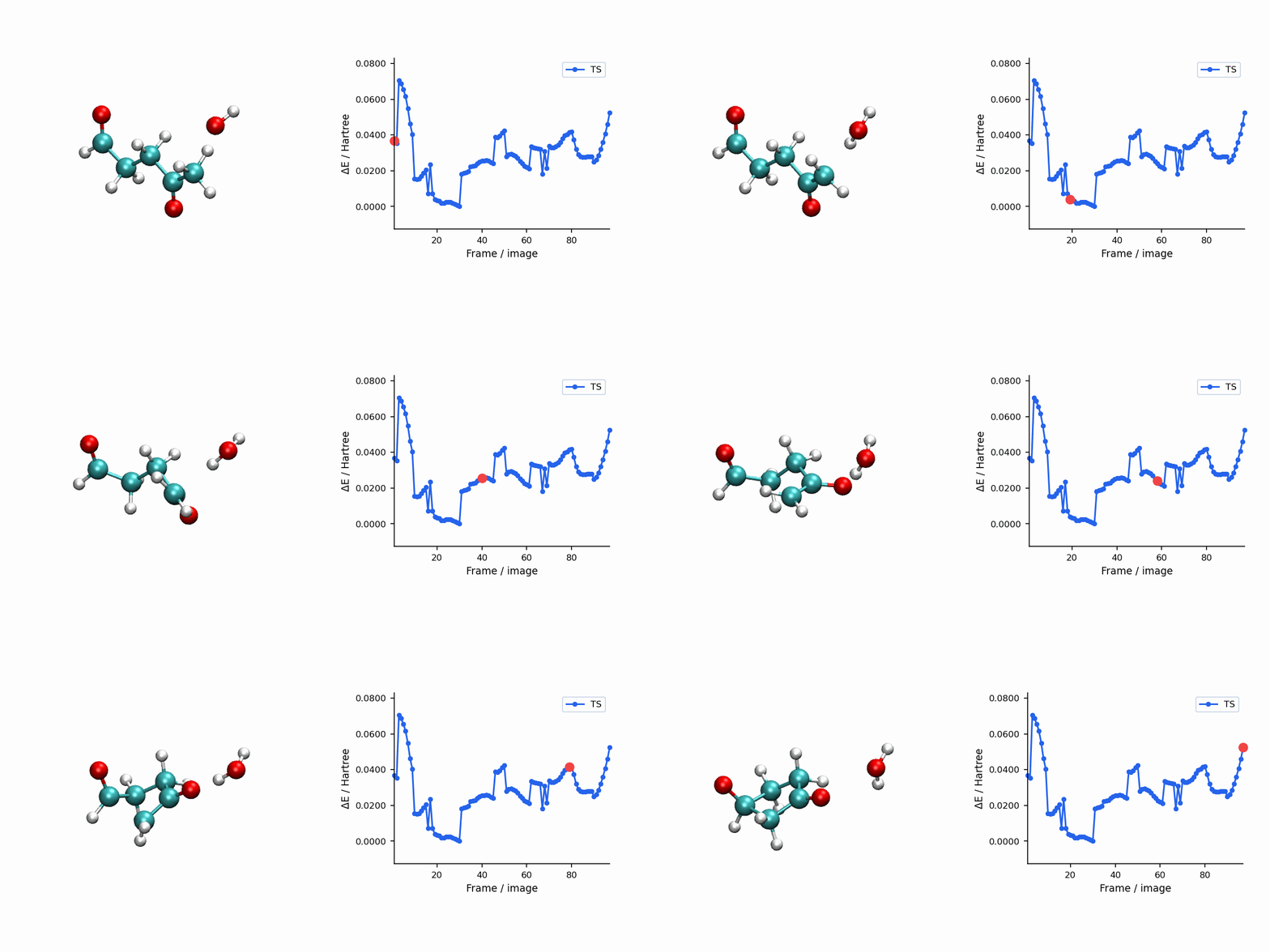
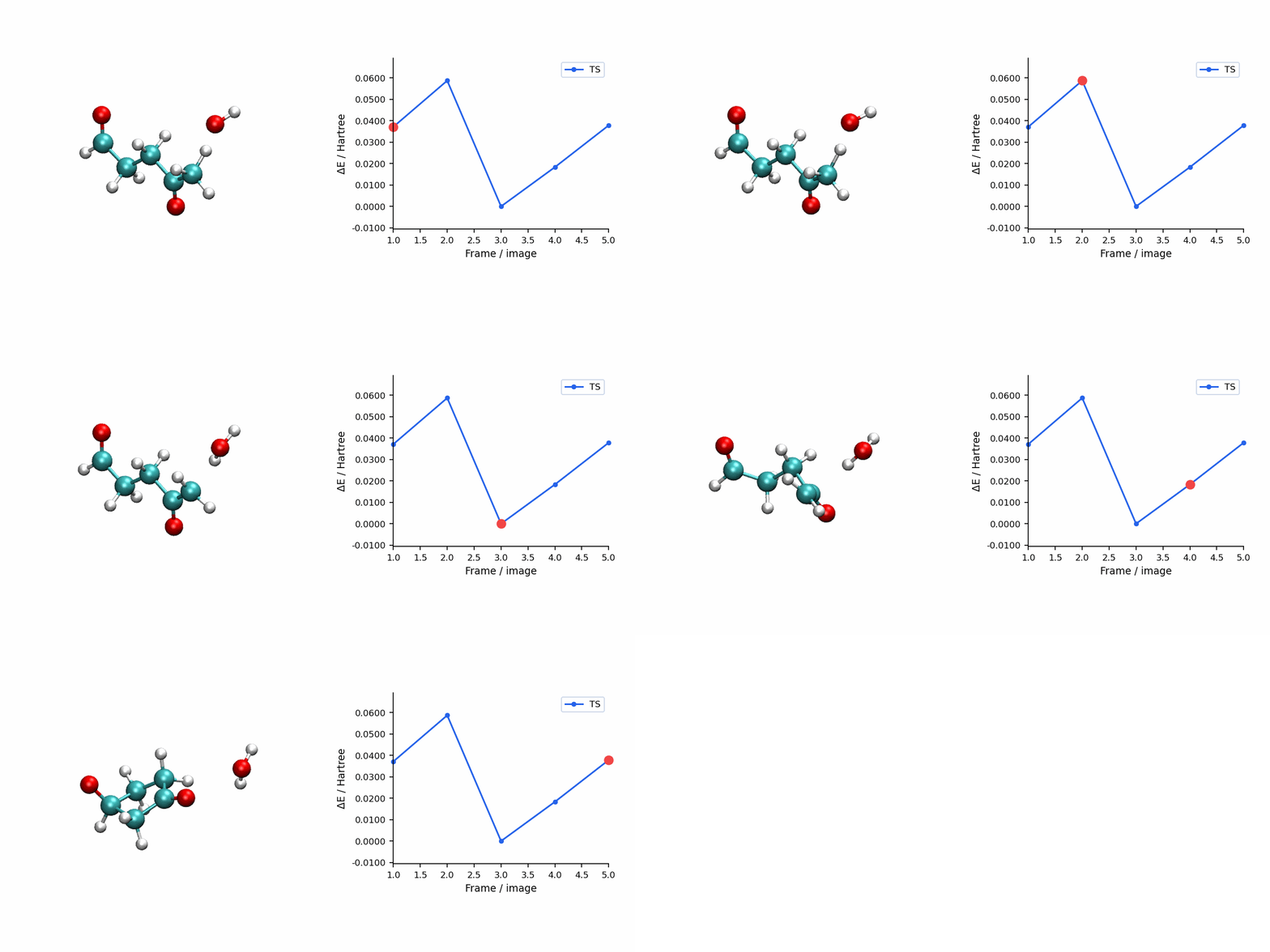
AutoNEB is ideal for reactions with multiple intermediates, such as enzyme mechanisms, catalytic cycles, or multi-step organic transformations. If you suspect your reaction has more than one elementary step, AutoNEB can discover the full mechanism automatically without requiring you to guess the intermediates.
AutoNEB can be computationally expensive for deep reaction networks. Each level of recursion spawns additional NEB calculations, and the total cost grows with the number of elementary steps discovered. For very complex mechanisms, consider limiting max_depth or using a smaller n_images value for the initial exploration, then tightening selected segments in separate follow-up calculations.